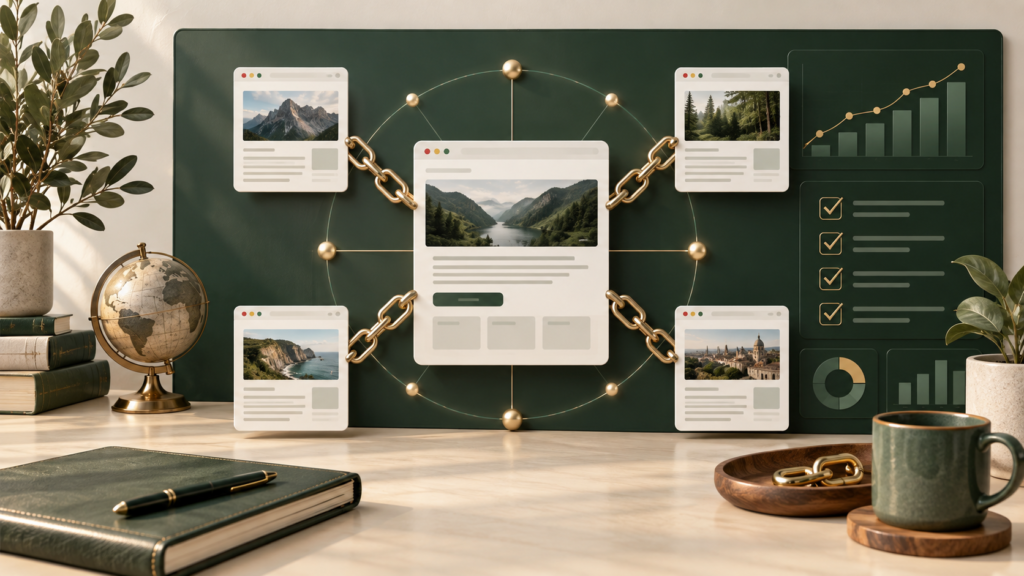
A successful link building strategy is not simply a plan to acquire more backlinks. It is a structured process for deciding which pages need authority, which publishers are relevant, what type of placement fits each goal, and how results will be measured.
Quick answer: A link building strategy connects business goals, target pages, content assets, publisher selection, outreach, anchor text, and performance tracking. The aim is not to collect the highest possible number of links. It is to earn or secure relevant placements that support useful pages and make sense to real readers.
Without that structure, link building often becomes a list of disconnected placements. A team may build links to the wrong pages, rely too heavily on one anchor type, choose websites based on a single metric, or continue spending without knowing whether the campaign is working.
This guide explains how to build a practical link building strategy from the ground up.
What Is a Link Building Strategy?
A link building strategy is a documented plan for attracting, earning, or acquiring backlinks from relevant third-party websites.
It should answer six questions:
- What business or SEO goal are we supporting?
- Which pages should receive links?
- Why would another website link to those pages?
- Which publishers and audiences are relevant?
- Which link-building methods fit the campaign?
- How will quality and results be measured?
Link building strategy vs. link building tactics
A strategy provides direction. Individual tactics—such as guest posting, digital PR, niche edits, resource-page outreach, or unlinked-mention reclamation—are the methods used to execute that strategy.
Why Random Backlink Acquisition Usually Underperforms
More backlinks do not automatically produce better results. A campaign can generate dozens of placements and still underperform if the links are irrelevant, the destination pages are weak, or the publishers have no meaningful connection to the business.
Common problems with unplanned campaigns include:
- Sending every backlink to the homepage
- Targeting keywords without reviewing search intent
- Selecting websites only by DA or DR
- Repeating exact-match commercial anchors
- Building links to pages that cannot satisfy visitors
- Using the same placement type for every objective
- Ignoring internal links and on-page SEO
- Measuring the number of links instead of their usefulness
- Expecting predictable ranking gains from individual placements
A good strategy does not remove uncertainty from SEO. It creates a clearer reason for every link and a better framework for evaluating outcomes.
Step 1: Define the Goal of the Campaign
Start with the outcome the campaign is expected to support.
Possible goals include:
- Improving the visibility of a commercial service page
- Building authority around a priority topic
- Supporting a newly published guide or resource
- Earning relevant referral traffic
- Increasing brand mentions within an industry
- Closing a backlink gap with competing pages
- Strengthening a website before entering a more competitive search category
Avoid vague goals such as “increase authority” without defining what authority should help accomplish.
A more useful objective would be:
Build relevant links to our SaaS reporting guide and supporting articles to improve topical coverage, attract qualified referral traffic, and strengthen the guide’s ability to compete for reporting-related searches.
This objective identifies the topic, target content, intended audience, and expected outcome.
Step 2: Choose the Right Target Pages
Not every page should receive the same link-building investment.
Create a shortlist of pages based on their business value, organic potential, current visibility, and ability to satisfy search intent.
Commercial pages
Service, category, product, or landing pages can be important targets, but they are not always easy to promote directly. Publishers may be reluctant to cite a page that exists mainly to sell something.
Commercial pages often need support from useful informational content and strong internal links.
Informational resources
Guides, studies, templates, statistics pages, tools, and original research are usually easier to reference naturally. These assets can attract links while passing internal authority toward relevant commercial pages.
Pages already close to performing
A page ranking near the first page may be a more practical initial target than a weak page with limited content and no visibility. However, backlinks should not be treated as a substitute for fixing poor content, technical problems, or search-intent mismatch.
Before building links, confirm that the target page:
- Serves a clear search intent
- Offers useful and accurate information
- Has a focused title and heading structure
- Loads and functions correctly
- Includes appropriate internal links
- Has a genuine reason to be cited
- Provides a suitable next step for visitors
Step 3: Review the Current Backlink Profile
Use our backlink audit checklist to record source pages, destinations, context and prioritized fixes before starting new acquisition.
A baseline review helps prevent the new campaign from repeating existing weaknesses.
Record:
- The pages currently receiving the most backlinks
- The types of websites linking to the domain
- The relevance of existing referring domains
- Frequently used anchor text
- Lost or broken backlinks
- Links pointing to redirected or deleted pages
- Important pages receiving few or no useful links
- Unusual patterns that require closer investigation
The purpose is not to label every unfamiliar backlink as harmful. It is to understand the current distribution and identify gaps.
For example, a website may already have many branded links to its homepage but very few relevant links to its main guides or service clusters. Its next campaign should probably focus on deeper pages rather than adding more homepage links.
Step 4: Analyse Competitors Without Copying Them Blindly
Competitor backlink research can reveal publications, resource pages, industry associations, and content formats that already attract links in your market.
Compare pages competing for the same search intent and look for:
- Publishers linking to several competitors
- Relevant sites that have not linked to you
- Content formats repeatedly earning citations
- Topics receiving links across the industry
- Competitor pages with strong links but weak content
- Broken or outdated resources that could be replaced
- Interviews, expert roundups, tools, or research receiving attention
A competitor backlink is an opportunity to investigate, not automatic proof of quality. The linking site may be irrelevant, inactive, overloaded with commercial links, or unsuitable for your brand.
Review every prospect independently.
Step 5: Create or Improve Link-Worthy Assets
Publishers need a credible reason to reference a page.
Link-worthy assets may include:
- Original research or survey findings
- Industry benchmarks
- Free calculators or tools
- Downloadable templates
- Practical checklists
- Expert-led guides
- Clearly explained technical concepts
- Updated statistics collections
- Case studies with transparent methodology
- Visual resources that simplify a difficult topic
A generic article that repeats existing search results is unlikely to earn strong editorial citations. The page should provide something easier to use, more current, more specific, or better supported than the alternatives.
Our guide to editorial links explains how useful resources, first-party data, and expert contributions can give publishers a genuine reason to cite a page.
Step 6: Select the Right Link-Building Methods
Most campaigns benefit from using more than one method. The right combination depends on the target page, available assets, timeline, budget, and level of editorial control required.
| Method | Best suited for | Main consideration |
|---|---|---|
| Editorial links | Research, tools, statistics and expert resources | The publisher should have a genuine editorial reason to cite the page |
| Guest posting | Brand visibility, topic ownership and controlled content development | The publication, topic and audience must be relevant |
| Niche edits | Adding a useful reference to an existing relevant article | The destination must naturally improve the existing context |
| Digital PR | Original data, expert commentary and newsworthy stories | The idea needs a real angle beyond acquiring a backlink |
| Resource-page outreach | Useful tools, guides and educational resources | The page must fit the resource list and help its audience |
| Unlinked mentions | Brands or experts already mentioned without a link | A link should improve the usefulness of the existing mention |
| Broken-link outreach | Replacing outdated or unavailable resources | The replacement must genuinely serve the same reader need |
| Partnerships | Suppliers, associations and legitimate business relationships | The link should accurately represent the relationship |
If you are deciding between new contributed content and an existing-page placement, review our comparisons of guest posting vs niche edits and link insertions vs guest posts.
Step 7: Establish Publisher Quality Standards
Do not approve a publisher based on one third-party authority score.
A practical review should consider:
Topical relevance
The publication’s subject matter and audience should have a logical relationship with the target page.
Page-level context
The specific article or proposed topic should support the link naturally. A relevant domain cannot rescue an unrelated placement.
Organic visibility
Review whether the website has genuine search activity, which pages attract traffic, and whether that visibility is reasonably connected to its stated niche.
Editorial standards
Look for identifiable authors, clear topics, readable articles, consistent publishing standards, and signs that content is reviewed before publication.
Outbound-link behaviour
A website publishing large numbers of unrelated commercial articles or linking to questionable industries from every page requires additional scrutiny.
Audience and business legitimacy
Check whether the publication appears to serve real readers or exists mainly to sell links.
Indexation and maintenance
Confirm that important pages are indexed, accessible, maintained, and not routinely removed shortly after publication.
For a fuller supplier-vetting framework, see our guide on how to choose a guest posting service. When you are reviewing one specific opportunity, use our link placement evaluation checklist before approval.
Step 8: Plan Destination Pages and Anchor Text Together
Anchor text should help readers understand the destination. It should not be forced around a target keyword simply because that keyword is commercially valuable.
A balanced campaign may naturally include:
- Brand names
- Plain URLs
- Article or resource titles
- Descriptive partial-match phrases
- General contextual phrases
- Occasional exact-match anchors when they genuinely fit
There is no universal percentage that every website must follow. The right distribution depends on the brand, existing backlink profile, destination page, publisher wording, and surrounding context.
| Target page | Page purpose | Preferred context | Example anchor direction |
|---|---|---|---|
| Research guide | Earn citations | Data, statistics or methodology discussions | Research title or descriptive phrase |
| Service page | Support commercial visibility | Closely relevant industry or service content | Brand or natural partial-match phrase |
| Comparison article | Capture evaluation intent | Decision-making and alternative comparisons | Article title or comparison phrase |
| Homepage | Brand discovery | Company profiles, partnerships and mentions | Brand name or URL |
Publishers should retain reasonable editorial control. If an anchor sounds unnatural in the sentence, change it.
Step 9: Build a Focused Prospect List
A smaller, carefully reviewed prospect list is usually more useful than thousands of loosely related domains.
Organise prospects by:
- Industry or topic
- Country and audience
- Publication type
- Relevant author or editor
- Existing article opportunity
- Target page
- Proposed value
- Preferred link-building method
- Contact status
- Quality-review status
Remove prospects that fail your basic relevance or quality checks before outreach begins. This saves time and reduces the temptation to accept weak placements simply because someone replied.
Step 10: Personalise Outreach Around Publisher Value
Outreach should explain why the proposed contribution, source, or update helps the publisher’s audience.
A useful pitch normally includes:
- A clear reason for contacting that specific person
- A relevant article, section, or audience need
- The value of the proposed resource or contribution
- A simple next step
- No exaggerated claims or ranking promises
Avoid sending the same generic message to several people at one company simultaneously. Start with the most relevant contact and keep the message focused.
The purpose of personalisation is not to add artificial compliments. It is to show that the opportunity was selected for a real reason.
Step 11: Sequence the Campaign
Link building should develop around priorities instead of releasing unrelated placements at random.
A simple 90-day sequence could look like this:
Days 1–30: Preparation
- Confirm campaign goals
- Select target pages
- Fix content and technical issues
- Review existing backlinks
- Analyse competing pages
- Prepare link-worthy assets
- Define publisher standards
- Build the first prospect list
Days 31–60: Outreach and initial placements
- Begin with the highest-relevance prospects
- Test outreach angles
- Pursue editorial citations and suitable contributions
- Review every proposed site and page
- Monitor replies, referral activity and placement quality
Days 61–90: Evaluate and expand
- Compare results by publisher and placement type
- Identify which target pages need additional support
- Improve weak outreach angles
- Expand successful topic clusters
- Reclaim lost or unlinked mentions
- Update the next campaign based on evidence
The exact timeline will vary. The important principle is to review quality and performance before increasing volume.
Step 12: Strengthen Internal Links
External backlinks are only one part of the authority path.
A linked informational page should connect readers to relevant supporting guides, comparison pages, and commercial services. Internal links help distribute context and make it easier for visitors and search engines to understand how the site’s topics relate.
Use descriptive anchors and link only where the destination provides a useful next step.
For example, a guide explaining publisher placements may naturally link to an overview of what a guest posting service includes. An agency-focused section may direct readers to guidance on choosing an SEO reseller for white-label link building.
Step 13: Measure Outcomes That Matter
Do not evaluate a campaign only by counting live links.
Track metrics connected to the original goal:
- Number of relevant referring domains
- Quality and relevance of linking pages
- Referral traffic
- Qualified enquiries or conversions
- Visibility of the target page
- Rankings across a topic cluster
- New brand mentions
- Publisher relationships developed
- Links retained over time
- Cost and effort by placement type
- Performance of pages receiving internal support
Rankings can change for many reasons, including content updates, technical changes, competition, and search-system updates. Avoid assigning every movement to one backlink.
A useful campaign report should distinguish between:
- What was built
- Why it was selected
- What changed afterward
- What cannot be confidently attributed to the links
- What should be tested next
A Practical Link Building Strategy Checklist
- The business and SEO goal is documented
- Priority target pages are selected
- Target pages satisfy search intent
- Existing backlinks and anchors have been reviewed
- Competitor opportunities have been evaluated manually
- At least one useful link-worthy asset exists
- Publisher acceptance criteria are documented
- Link-building methods match the campaign goals
- Destination pages and anchor direction are mapped
- Prospects are relevant at both domain and page level
- Outreach explains value to the publisher
- Internal links support the target pages
- Performance metrics are defined before placements begin
- Commercial relationships are handled transparently
- No ranking outcome is being guaranteed
Common Link Building Strategy Mistakes
Prioritising volume over relevance
Ten closely relevant links can be more useful than a large collection of placements with no audience or topical connection.
Treating metrics as proof of quality
DA, DR, traffic estimates, and similar metrics are screening signals. They do not replace a manual review of the publication and linking page.
Building links before improving the page
A backlink may bring visibility or referral traffic, but it cannot make a thin, confusing, or misaligned page useful.
Sending every link to commercial pages
Supporting resources can earn links more naturally and strengthen commercial pages through carefully planned internal links.
Repeating exact-match anchors
Forced anchor patterns reduce readability and may create an unnatural-looking profile.
Ignoring publisher behaviour
A website can appear strong at domain level while publishing unrelated sponsored content or maintaining weak individual pages.
Scaling before reviewing results
If the initial placements are weak, increasing volume only makes the problem larger. Review the first stage before expanding.
Link Building and Google’s Spam Policies
Google’s spam policies identify buying or selling links for ranking purposes and excessive link exchanges as forms of link spam. Google also explains how to qualify sponsored and other outbound links when a relationship needs to be disclosed.
A responsible strategy should distinguish between genuine editorial citations, contributed content, partnerships, advertising, and commercial placements. Do not label every contextual backlink as independently earned.
The safest long-term principle is straightforward: create useful destinations, select relevant publishers, maintain editorial standards, and avoid tactics designed primarily to manipulate rankings.
Frequently Asked Questions
What is the best link building strategy?
There is no single strategy that works for every website. The best approach depends on the target pages, industry, competition, available content, audience, resources, and existing backlink profile. Most campaigns benefit from combining useful content assets, focused outreach, relevant publisher relationships, and strong internal linking.
How many backlinks should I build each month?
There is no universal monthly number. Set the pace according to the size of the market, quality of available publishers, campaign resources, and ability to maintain proper review standards. A small number of relevant placements is preferable to scaling weak links simply to meet a quota.
How long does link building take to work?
Outreach and placements may begin producing referral visits or brand exposure quickly, but organic search outcomes can take longer and cannot be guaranteed. Results depend on the target page, competition, technical condition, content quality, link relevance, and wider search environment.
Should backlinks point to the homepage or internal pages?
A natural profile can include both. The correct destination depends on the context. Brand mentions may point to the homepage, while topic-specific articles should usually link to the most useful relevant guide, tool, category, or service page.
Are guest posts still useful for link building?
Guest posts can support visibility, expertise, referral traffic, and relevant backlinks when the publication has a real audience, the topic fits, and the content meets editorial standards. Our guest posting service guide explains the process and quality checks in more detail.
Should I use guest posts or niche edits?
Guest posts are useful when you need a new article, stronger topic control, or additional brand visibility. Niche edits can fit when an existing article already provides the right context and your destination genuinely improves it. Neither method should be selected without reviewing relevance and publisher quality.
Can link building guarantee higher rankings?
No. Backlinks are one part of a broader SEO system. Content quality, intent alignment, technical SEO, competition, internal linking, and search-system changes can all affect visibility. A credible provider should not guarantee a specific ranking from a placement.
Final Takeaway
A strong link building strategy gives every placement a clear purpose.
Start with business goals and suitable target pages. Create resources worth referencing. Select publishers based on relevance and editorial quality. Use natural anchors, focused outreach, and a sensible mix of methods. Finally, measure outcomes against the original objective instead of treating the number of acquired links as the result.
MavaOak helps SEO teams and agencies review publisher opportunities around topical fit, organic activity, editorial standards, and campaign requirements. Before anything moves forward, clients can review the proposed opportunities and decide whether they fit the campaign.
To understand the available approaches, review our link-building services or see how the MavaOak campaign process works.

Rehan Anwar is the owner of MavaOak, an agency focused on guest posting, blogger outreach and link building. He shares practical guidance on publisher selection, content relevance and outreach processes.
Leave a Reply